
Technology
Jacquard: woven fabric, knit, webbing and woven pictures
One word, four different products. How they differ, and what a picture woven on a Jacquard loom looks like.
Jacquard is a textile in which the pattern is formed in the structure of the material, by controlling individual threads. The word describes how the pattern is made. It says nothing about the fibre or the weight. This is why a heavy upholstery fabric, a patterned sweater, a narrow tape with a logo and a picture woven from coloured yarns are all called jacquard. The name comes from the Jacquard machine, built at the start of the nineteenth century by Joseph Marie Jacquard.
Jacquard woven fabric
A woven fabric is made of two sets of threads, the warp and the weft. In a jacquard fabric the mechanism lifts every warp thread separately, so at every point it can be decided which thread lies on top. The pattern shows through differences in weave, sheen or colour. Damask, brocade and matelassé belong to this group. Jacquard fabrics are used for upholstery, curtains, tablecloths, bedding and formal wear.
Jacquard knit
A knitted fabric is built differently, from yarns formed into interlocking loops. In a jacquard knit the pattern comes from choosing which of the coloured yarns forms the loop at each point. It is made on knitting machines, which work on a different principle from looms. Jacquard knits are stretchy and soft, so they are used for sweaters, hats, scarves, sportswear and car upholstery.
Jacquard webbing, elastics and labels
The same principle is applied to narrow products. Narrow looms with a Jacquard machine weave webbing with a logo, elastics with lettering and clothing labels. Here the pattern has a few colours and recurs at a fixed interval, the repeat.
Comparison
| Type | Structure | Machine | Typical products |
|---|---|---|---|
| Jacquard woven fabric | Warp and weft, with the pattern formed by the interlacing. | A wide loom with a Jacquard machine. | Upholstery, curtains, bedding. |
| Jacquard knit | Loops of yarn in several colours. | A knitting machine. | Sweaters, hats, sportswear. |
| Jacquard webbing and labels | A narrow woven fabric with selvedges and a repeating pattern. | A narrow loom with a Jacquard machine. | Webbing with a logo, elastics, labels. |
| Large-format jacquard | A woven fabric in which the whole picture is one pattern. | A Jacquard loom controlling thousands of threads. | Woven pictures, emblems, decorative fabrics. |
Large-format jacquard: the woven picture
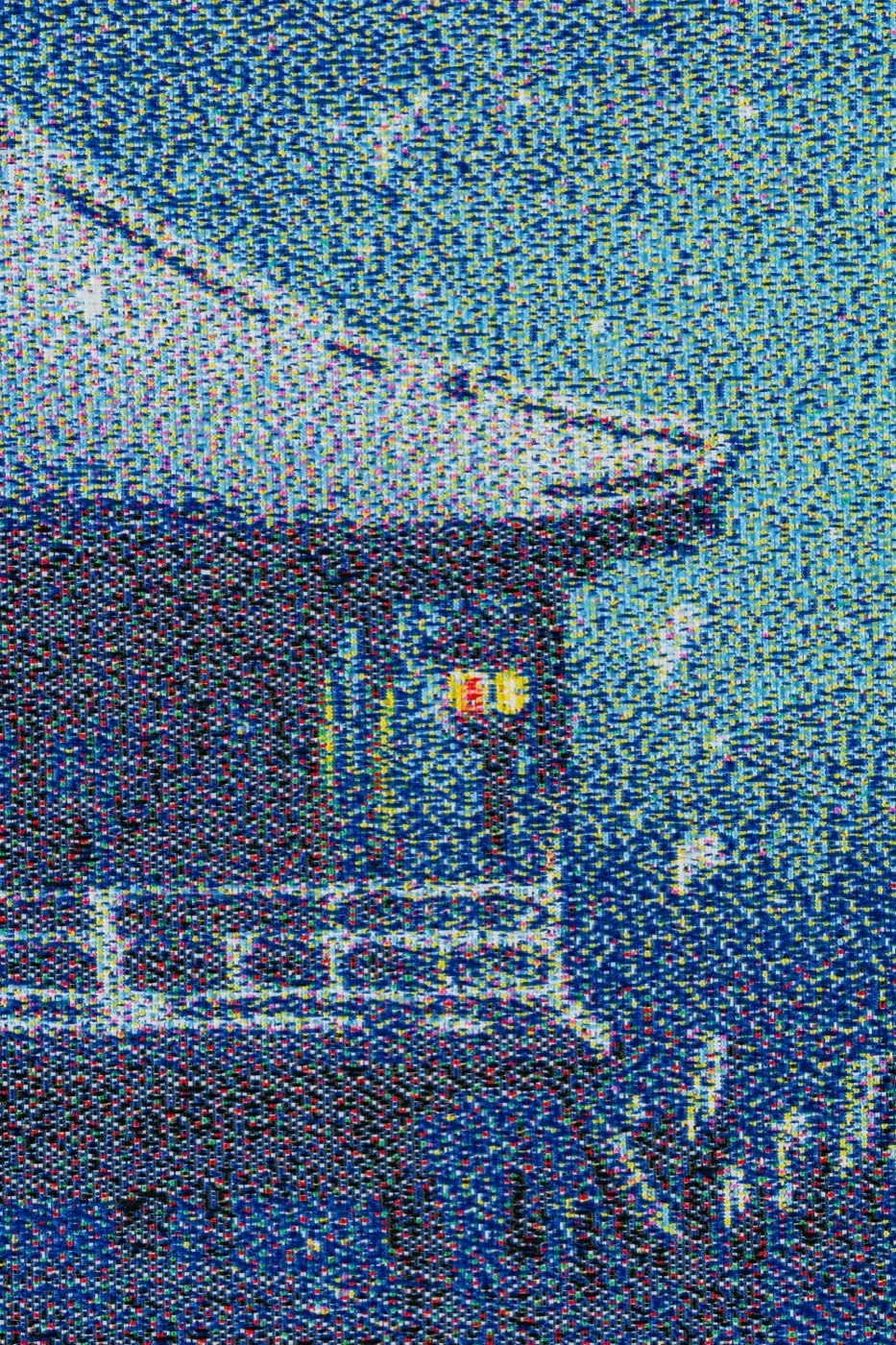
In a large-format jacquard the pattern does not recur in a short repeat. The whole surface is one picture, and each point of it comes from the crossing of threads of particular colours. Close up, single interlacings in several colours can be seen. From a distance the eye blends them into shades and tonal transitions, much like the dots of a printing screen.
This is where jacquard differs from tapestry. In hand-woven tapestry the weft covers the warp completely, and each area of colour is filled in with its own weft yarn. In jacquard the colours come from repeating series of warp and weft threads, which the machine brings to the surface or hides according to the programme.
Three pictures woven by SPLOT-PAS
Three pictures woven at the SPLOT-PAS mill show what the technique can do.
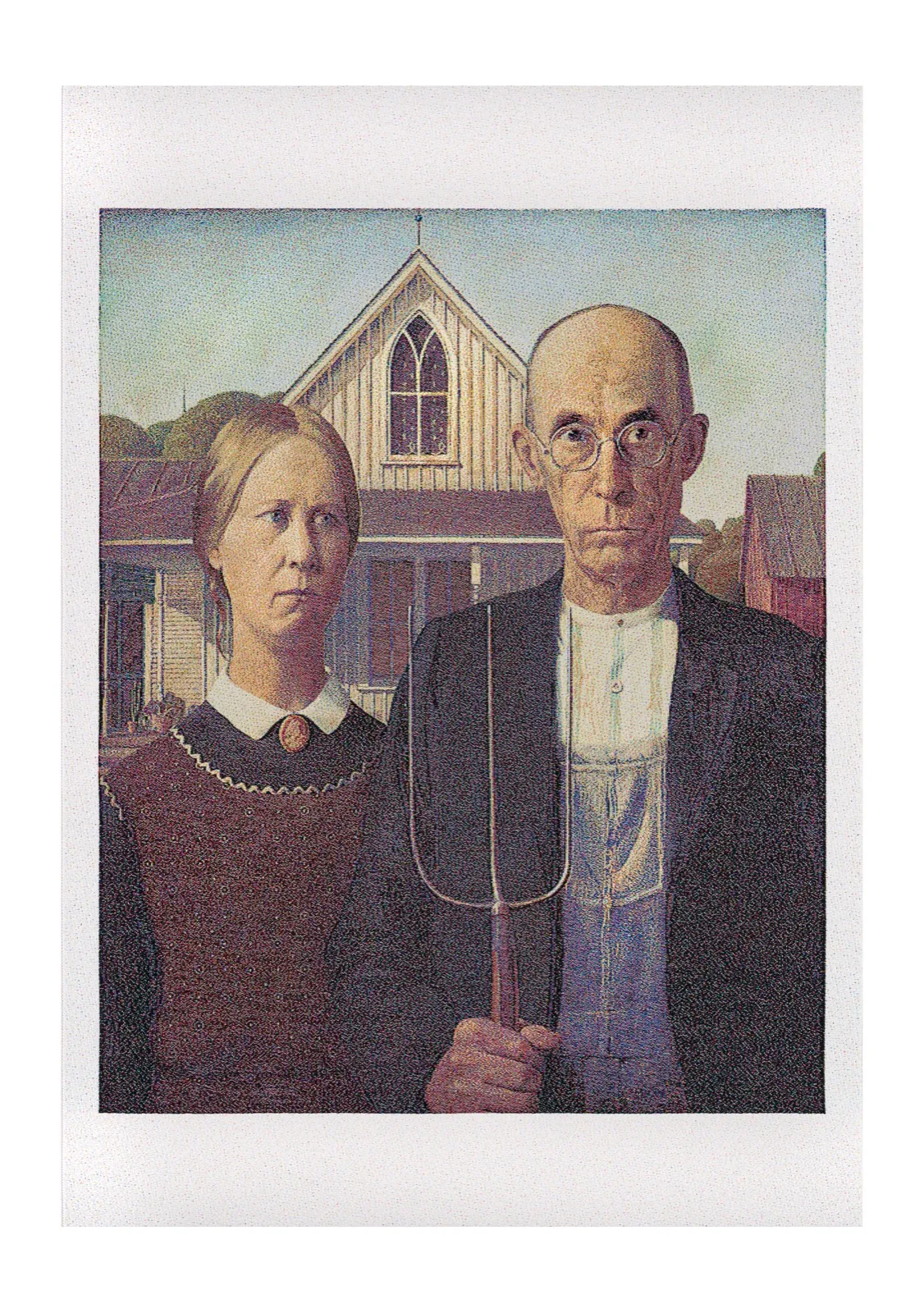
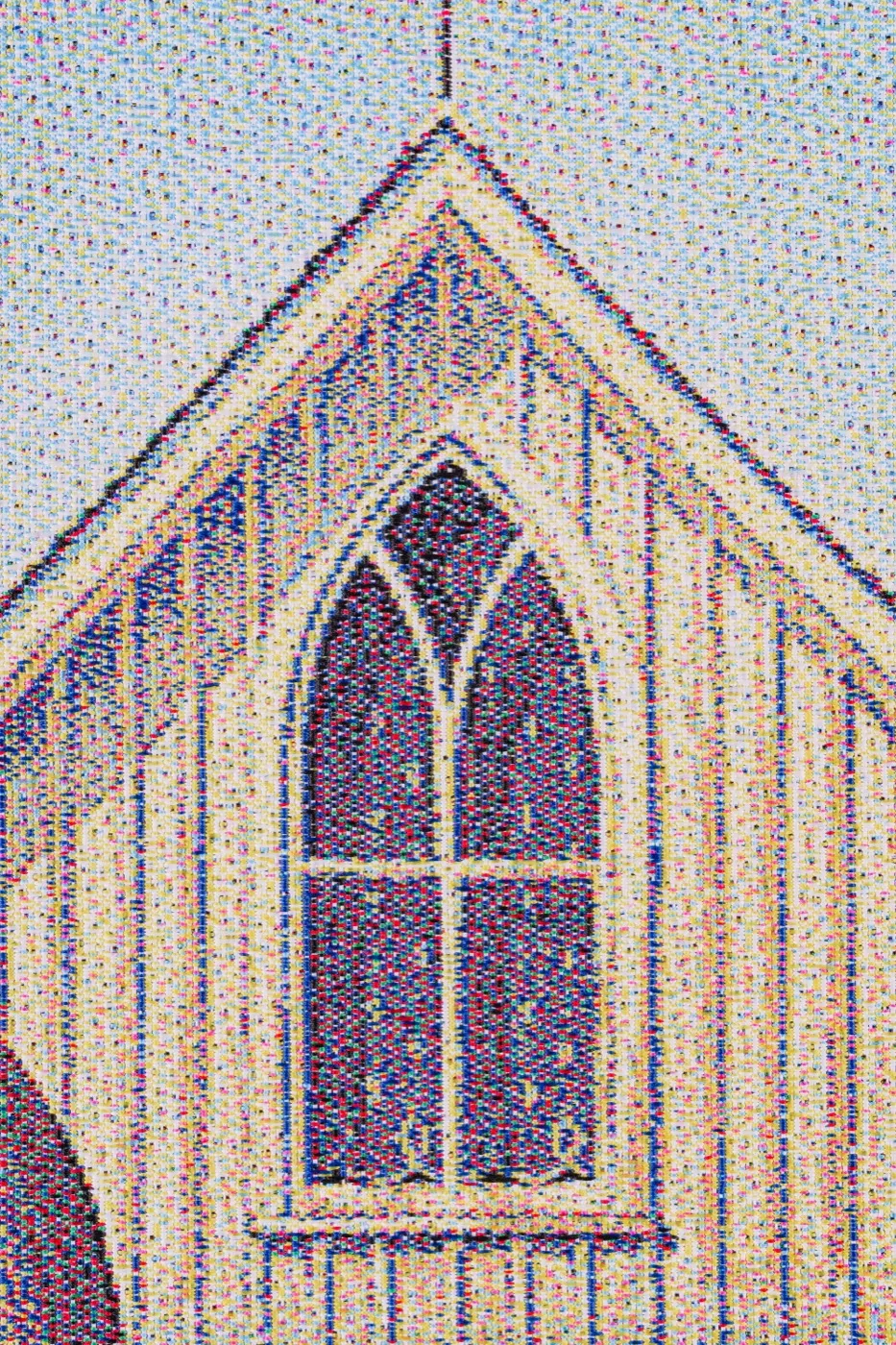
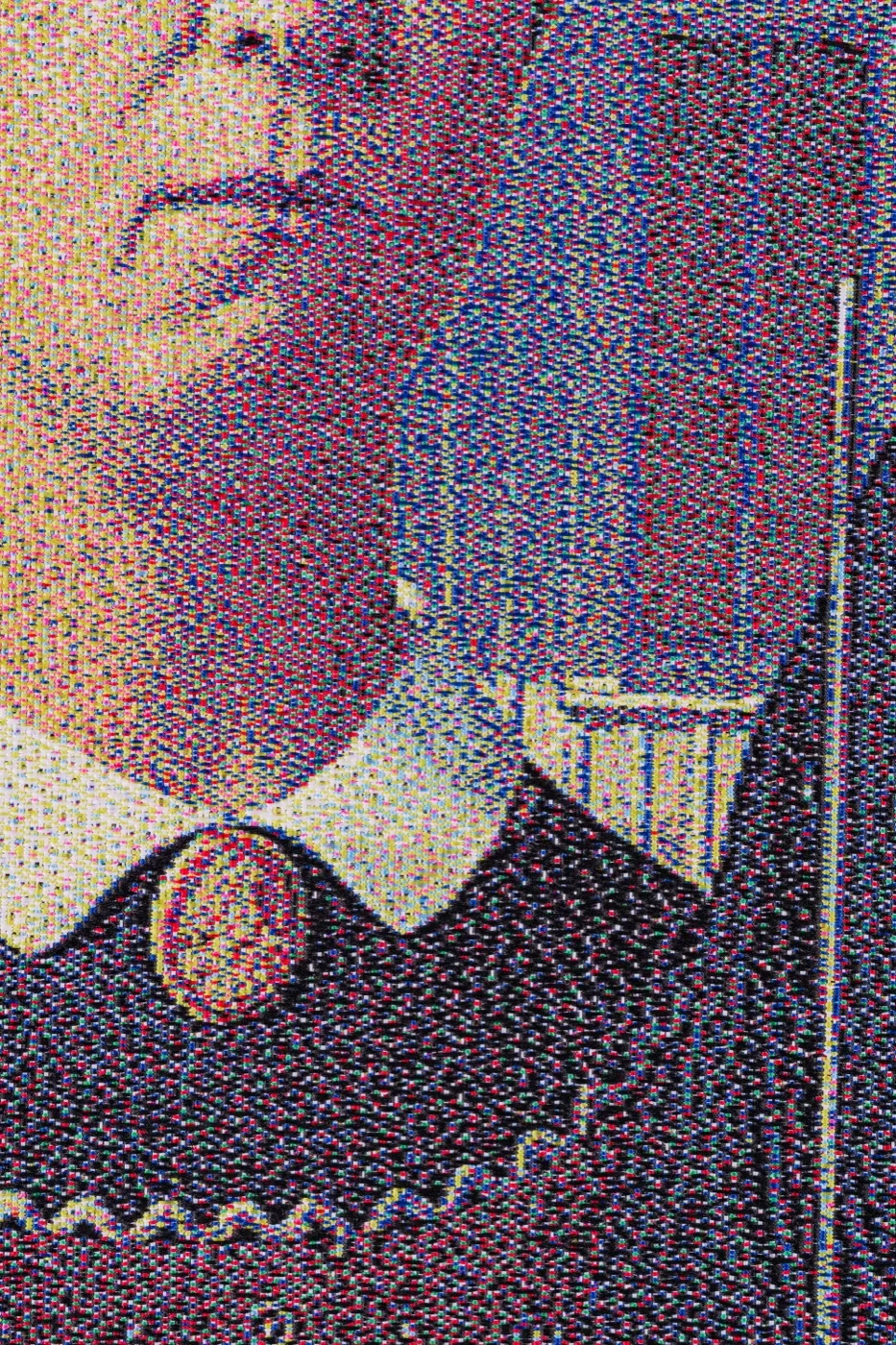
The first is “American Gothic”, after the painting by Grant Wood of 1930. The original, painted in oil on beaverboard, measures 78 by 65.3 cm and hangs in the Art Institute of Chicago. The woven version keeps the features of the faces, the Carpenter Gothic window in the gable of the house and the tines of the pitchfork. The close-ups show that the shadows on the faces are built from points in several colours.
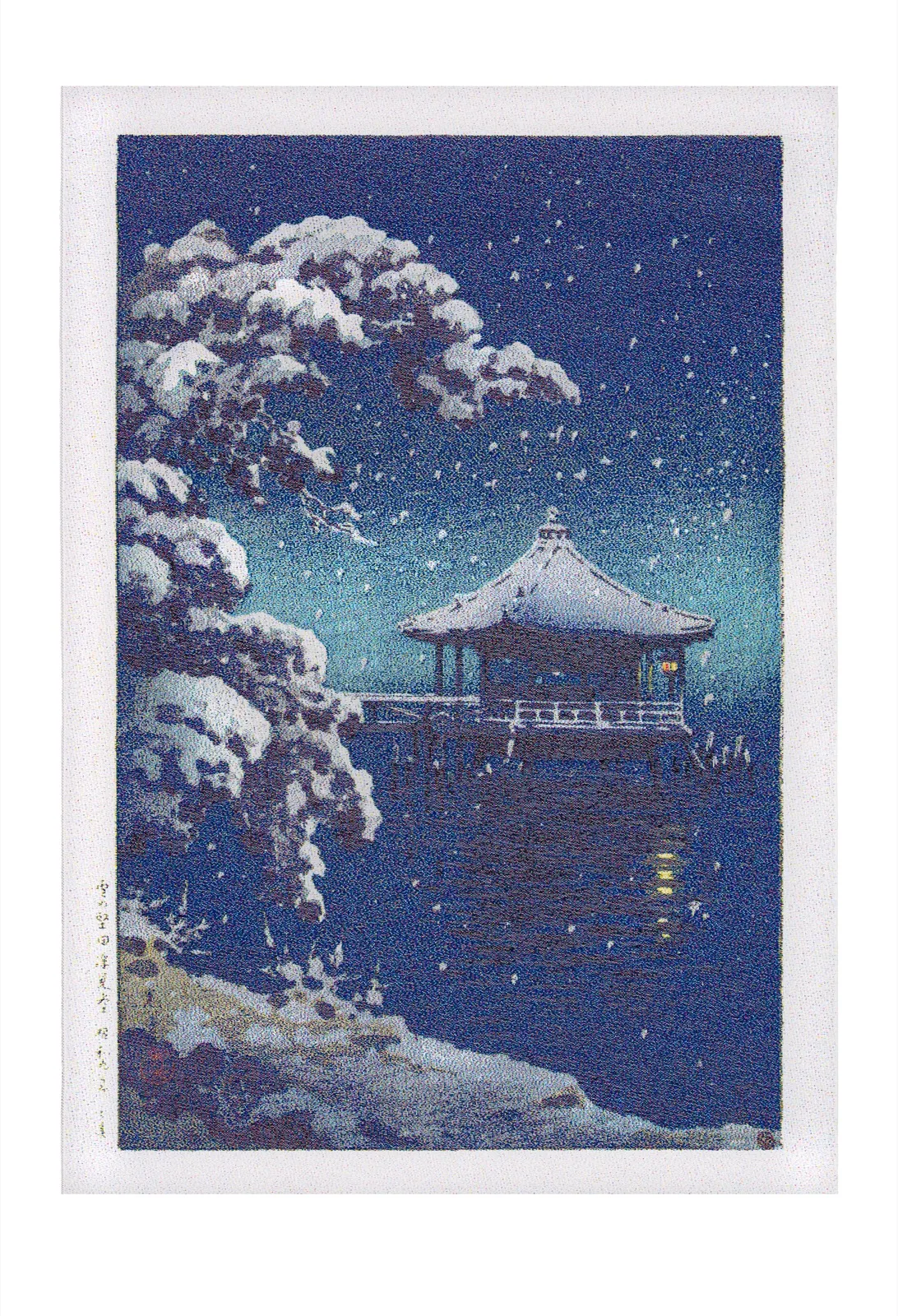
The second picture repeats the Japanese woodblock print “Snow at Katata, the Ukimidō pavilion”, designed by Tsuchiya Kōitsu (1870 to 1949). Kōitsu belonged to the shin-hanga movement, which revived the tradition of the Japanese colour woodcut in the first half of the twentieth century. The night scene with a snow-covered pine and a pavilion over the water rests on shades of dark blue. The yellow light of the lanterns is made by a few threads in a contrasting colour.
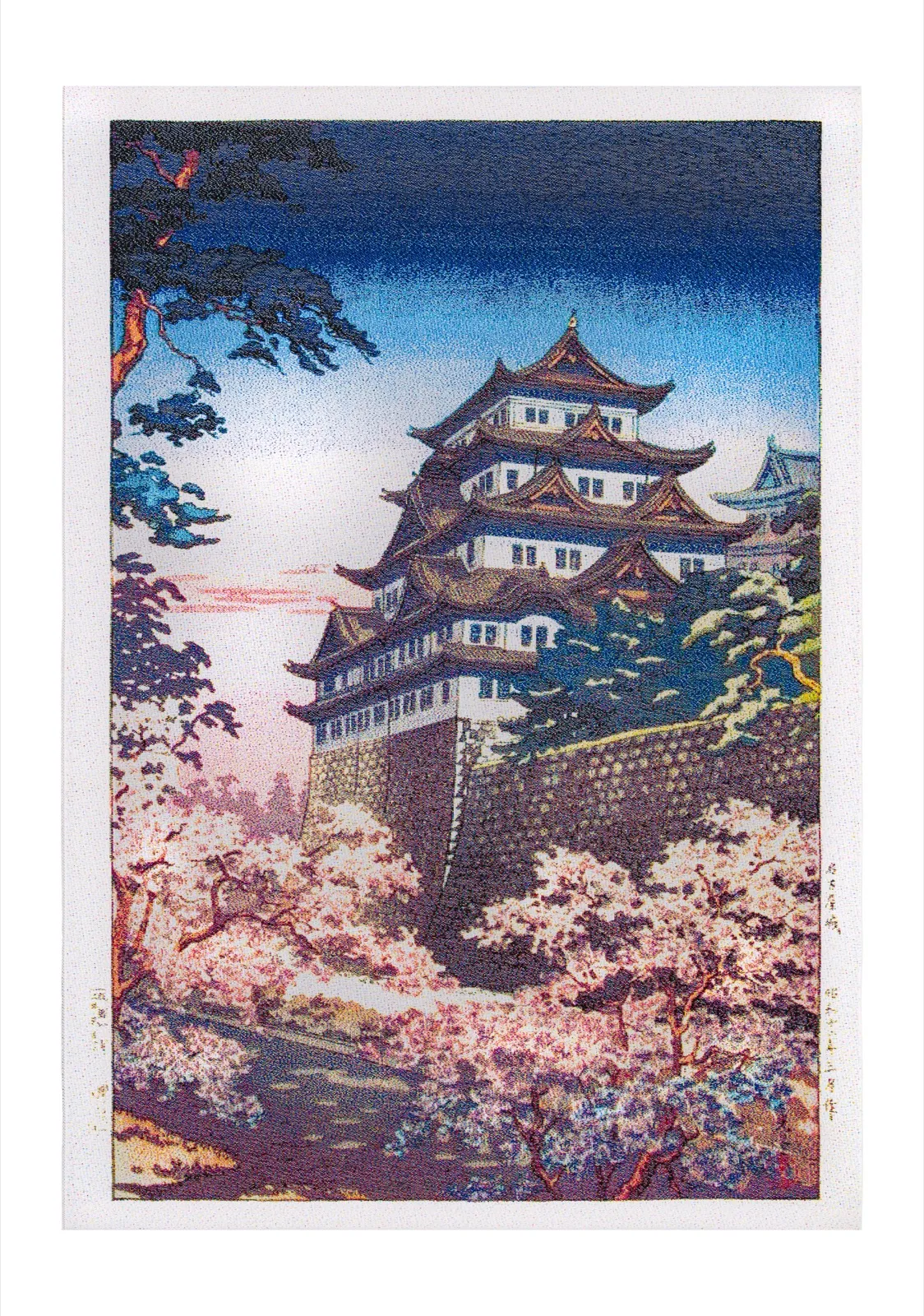
The third picture shows Nagoya Castle among cherry trees in blossom, also after a Japanese woodblock print. It is the most colourful of the three, with pink blossom, green roofs, an orange pine trunk and a sky that passes from pale to dark blue. A calligraphic signature is woven into the margin, in the place where it stands on the print.
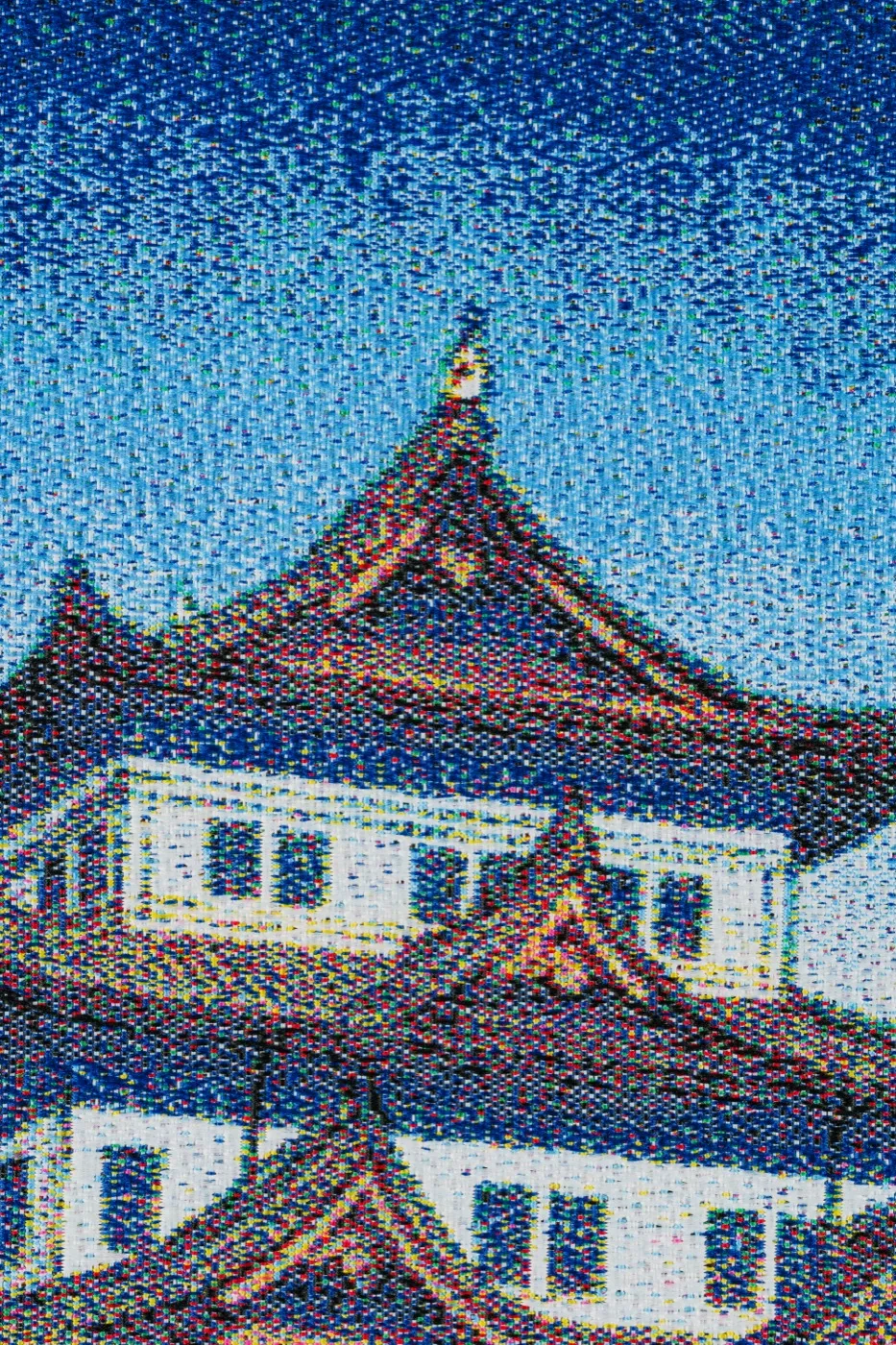
In all three works, details a few millimetres in size remain legible, such as the glazing bars of the window, the characters of the signature and single snowflakes.
Frequently asked questions
What is jacquard?
A textile with a pattern formed in the structure of the material, by controlling individual threads. It can be a woven fabric, a knit or a narrow tape.
How does a jacquard woven fabric differ from a jacquard knit?
A woven fabric is made by interlacing warp and weft on a loom. A knit is made of loops on a knitting machine and stretches more.
Is jacquard a print?
No. A jacquard pattern is made by the threads the material is built from, so it does not wear off or wash out.
How does a jacquard picture differ from a tapestry?
A tapestry is woven by hand, with each area of colour filled in by its own yarn. A jacquard picture is woven on a programme-controlled loom, and shades come from mixing coloured threads.
Sources
- Wikipedia, “Jacquard machine”, “Tapestry”, “American Gothic”, “Tsuchiya Koitsu” and “Shin-hanga”, en.wikipedia.org
- Wikipedia, “Dzianina”, pl.wikipedia.org
- Photographs: SPLOT-PAS