
Technology
The Jacquard machine: how the loom works and where it came from
The mechanism that has controlled every warp thread separately since the early nineteenth century, and gave computing the punched card.
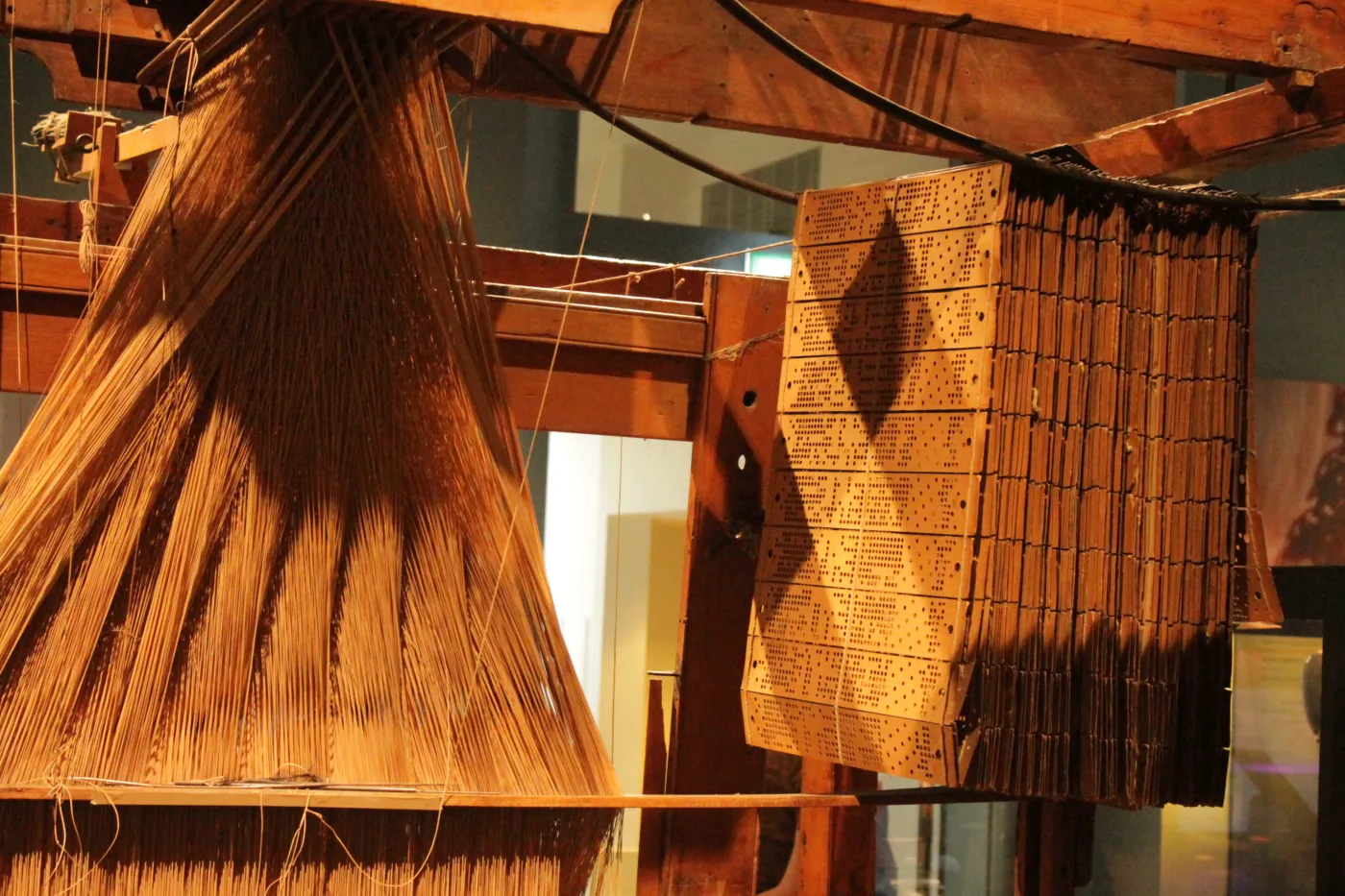
A Jacquard machine (Jacquard mechanism, Jacquard head) is a device mounted above a loom that lifts individual warp threads according to a stored programme. A loom fitted with it is called a Jacquard loom. It can weave any pattern, including ornaments, lettering, logos and portraits. The name comes from the French weaver Joseph Marie Jacquard (1752 to 1834) of Lyon, and fabrics made this way are called jacquards.
How it works
During weaving, some warp threads are raised and the rest stay down. The gap between them is the shed, and the weft thread passes through it. Which threads are raised in each row decides the pattern. On a loom without a Jacquard head, warp threads are grouped on a small number of shafts, so few patterns are possible. A Jacquard machine controls each thread, or a small group of threads, separately.
The classic mechanism worked as follows:
- The pattern was stored on punched cards laced into a continuous chain. One card stood for one row of weft.
- Each card was pressed against a square prism perforated on all four sides. The prism made a quarter turn for every pick and presented the next card.
- Horizontal needles were pushed against the card. A needle that met a hole passed through and stayed in place. A needle that met solid card was pushed back.
- Each needle acted on a vertical hook. Hooks left in the working position were caught by a rising beam, and the displaced ones stayed down.
- Harness cords hung from the hooks. Each cord ended in a heddle with an eye for one warp thread and a weight that pulled the thread back down.
A hole in the card meant a raised thread and no hole meant a lowered one, which is a binary record. The number of hooks sets the size of the machine. A 400-hook head with four threads tied to each hook controls 1,600 warp ends in a repeating pattern. Modern machines have thousands of hooks and can control more than 10,000 warp ends one by one.
History
Before Jacquard
Jacquard was not the first to try to automate pattern weaving. Earlier figured silks were woven on drawlooms, where an assistant pulled up groups of threads by hand.
- Basile Bouchon used a perforated paper band to control a loom in 1725.
- Jean-Baptiste Falcon replaced the band with a chain of punched cards in 1728 and increased the number of controlled threads. About 40 of his looms had been sold by 1762.
- Jacques de Vaucanson tried to automate Bouchon's mechanism around 1740, with further work between 1747 and 1750, using a perforated cylinder and needles that selected the hooks.
Jacquard's invention
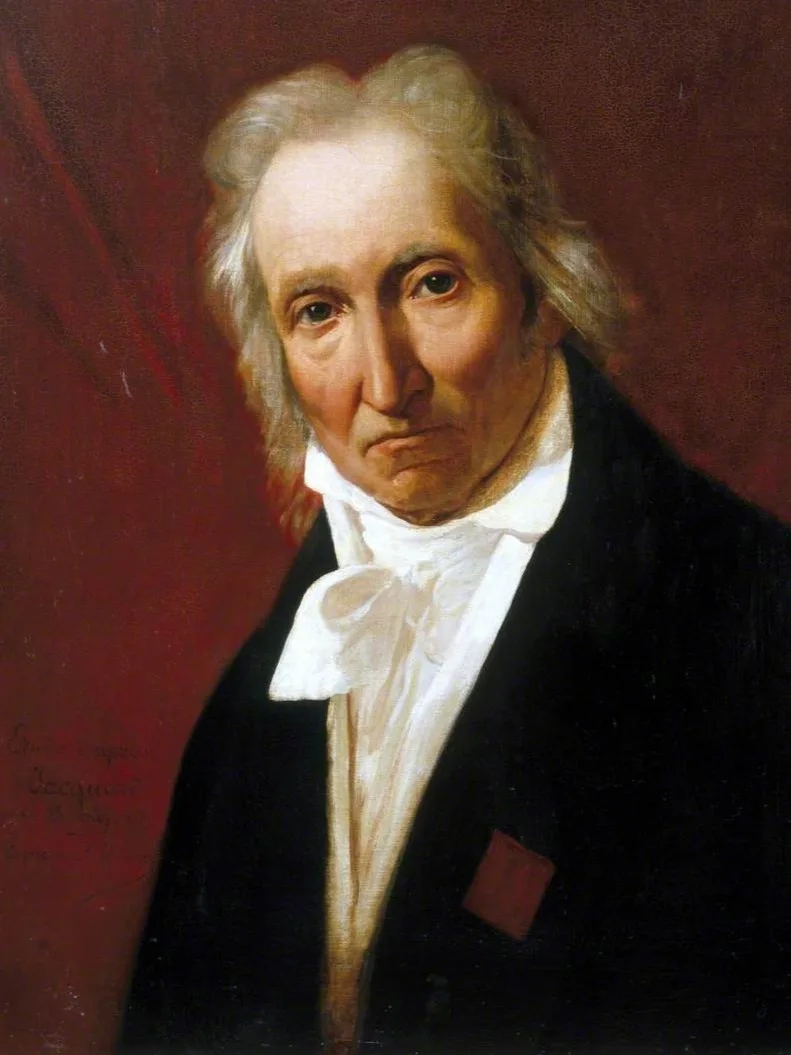
Joseph Marie Jacquard was born in Lyon on 7 July 1752, when the city was the centre of the European silk trade. In 1801 he showed his loom at the exhibition of French industrial products in Paris and received a bronze medal. In 1803 he joined the Conservatoire des Arts et Métiers, where he studied Vaucanson's loom. He combined his predecessors' ideas, Falcon's chain of cards and Vaucanson's automatic selection of hooks, into a machine that needed no assistant. Sources date the invention to 1804, the year of the patent, or to 1805. On 15 April 1805 Napoleon granted the patent to the city of Lyon, and Jacquard received a pension for life and a fee for every loom in use.
The silk weavers of Lyon opposed the machine because they feared for their jobs. Few machines were sold before 1815, when Jean Antoine Breton solved the problems with the cards. Jacquard died in Oullins on 7 August 1834. A statue of him was put up in Lyon a few years later.
A portrait woven from 24,000 cards
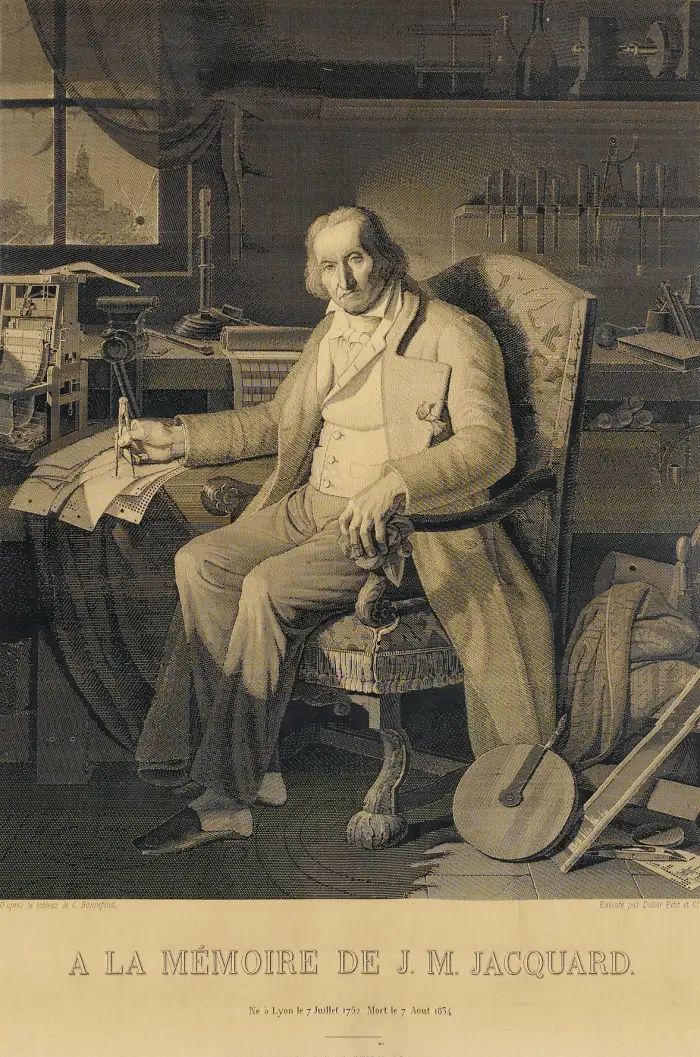
A well-known demonstration of the machine is a silk portrait of Jacquard woven in 1839. It needed about 24,000 punched cards, and from a distance it looks like an engraving. Charles Babbage owned a copy, which is now in the Science Museum in London.
Jan Szczepanik
In 1896 the Polish inventor Jan Szczepanik developed a way of preparing weaving patterns with photography, automatic card punching and electrical reading. It shortened the preparation of a programme for the loom, and he patented it in Germany, Austria, England and the United States.
Electronic machines
The first attempt to control a Jacquard with electromagnets was made in 1855 and failed. In 1983 Bonas Textile Machinery showed the first successful electronic Jacquard machine at the ITMA fair in Milan. In electronic machines a digital file replaces the cards and the hooks are selected electromagnetically, so a pattern can be changed in minutes.
The Jacquard loom and early computing
A punched card that records a yes or no for every thread was one of the first ways of storing a programme for a machine. Charles Babbage planned to use cards to hold programmes for his Analytical Engine. In 1843 Ada Lovelace compared the two machines: the engine would weave algebraic patterns as the Jacquard loom weaves flowers and leaves. Herman Hollerith used punched cards in the tabulating machines that processed the United States census of 1890, and his company later became part of IBM.
Jacquard looms today
Modern Jacquard looms fall into two groups:
- wide looms for upholstery fabrics, curtains, towels, bedding and clothing fabrics;
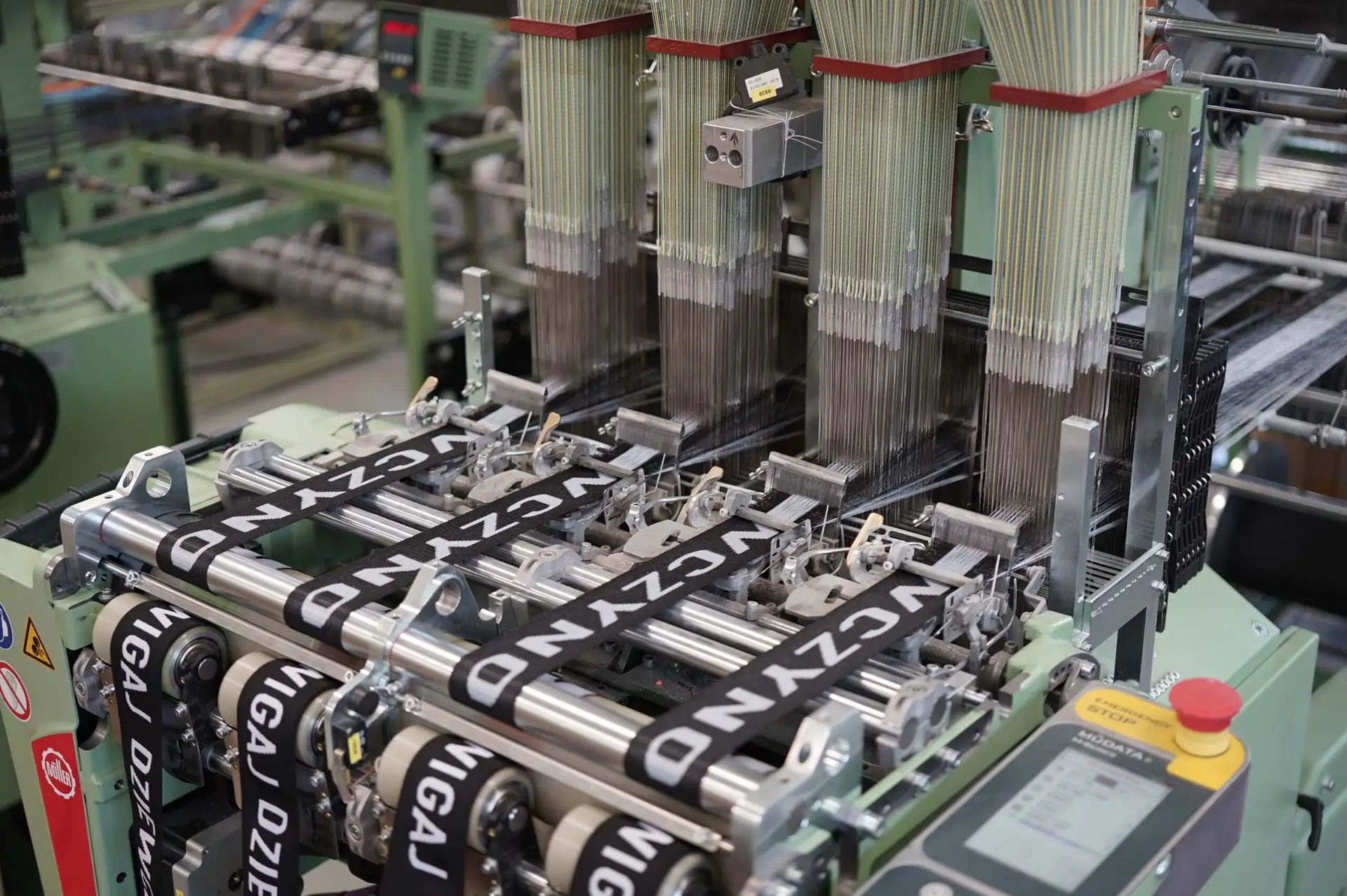
- narrow needle looms for jacquard webbing, elastic tapes with a logo and woven labels. A needle inserts the weft, and one machine weaves several tapes side by side.
Łódź, for more than a century the largest textile centre in Poland, still has mills that weave this way.
Frequently asked questions
Who invented the Jacquard loom?
Joseph Marie Jacquard of Lyon. He showed the machine in 1801 and the patent dates from 1804 to 1805. He built on the work of Bouchon (1725), Falcon (1728) and Vaucanson (about 1740).
How is a Jacquard loom different from an ordinary loom?
An ordinary loom lifts whole groups of warp threads in a few fixed sequences. A Jacquard loom controls each thread separately, so it can weave any pattern.
What do punched cards have to do with computers?
Jacquard cards stored a programme in binary form, as a hole or no hole. Babbage and Hollerith adopted the idea, and punched cards were used in computing until the 1970s.
Do Jacquard machines still use cards?
No. Electronic machines controlled by a digital file have been in use since the 1980s.
Sources
- Wikipedia, “Jacquard machine”, en.wikipedia.org
- Wikipedia, “Joseph Marie Jacquard”, en.wikipedia.org
- Wikipedia, “Maszyna żakardowa” (on Jan Szczepanik), pl.wikipedia.org
- A. A. Lovelace, translator’s notes to L. F. Menabrea’s paper on the Analytical Engine, 1843
- Loom photograph: Stephencdickson, Wikimedia Commons, licence CC BY-SA 4.0 (resized). Portraits: Science Museum and M. M. Carquillat, public domain


