Technology
Woven labels: how a jacquard label is made
A design woven from yarn instead of printed: how a jacquard label is built, how it is produced and what its price depends on.
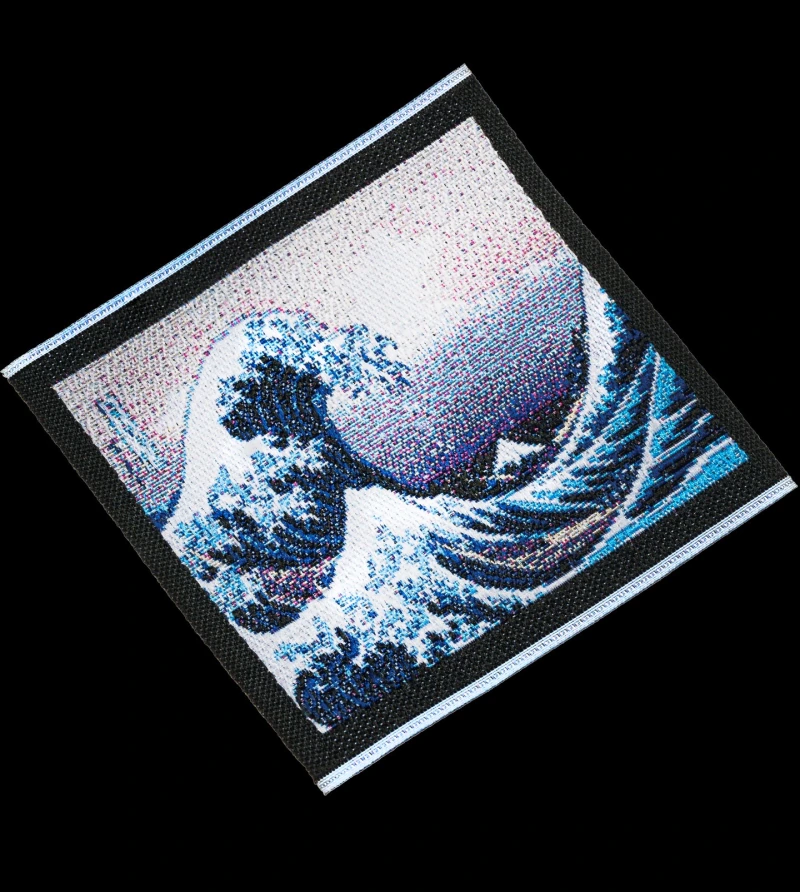
A woven label (jacquard label, jacquard woven label) is a label whose lettering, logo or pattern is woven from coloured yarns and forms part of the fabric. The technique is named after the Jacquard mechanism, invented at the start of the nineteenth century, which controls every warp thread separately (see The Jacquard machine).
How the pattern is formed
A woven fabric has two sets of threads: the warp, which runs lengthwise, and the weft, which crosses it. On a plain loom, groups of warp threads rise in a fixed, repeating sequence, which gives a simple weave such as plain, twill or satin. A Jacquard mechanism raises each warp thread independently. In every row of weft it decides which colour of yarn lies on the face, and row by row an image builds up from these points of interlacing.
In a woven label the ground is usually a warp of one colour. Wefts in several colours build the pattern: they are brought to the face where they should show and hidden on the back elsewhere. This is why the back of a label is a negative of its face, and why the number of weft colours is limited.
Production step by step
- Artwork review. The design, ideally a vector file, is checked for size, line thickness and letter height. Very small elements are simplified, because the finest possible detail depends on weave density (see How to design a custom woven label).
- Weaving programme. The artwork is converted into a map of interlacings that states which yarn lies on the face at each point. This used to be stored on punched cards and is now a file for an electronic Jacquard machine.
- Yarn selection. Colours are chosen from a yarn shade card. A brand colour given as Pantone or CMYK is matched as closely as possible, but yarn always looks slightly different from print or a screen.
- Weaving. Labels are woven as a tape with the design repeated side by side or end to end.
- Finishing. The tape is cut into single labels and the edges are sealed against fraying. Labels are left flat or folded.
- Inspection and packing. The labels are compared with the approved artwork or sample.
Label weaves
The label trade usually distinguishes three constructions, which differ in density and appearance:
| Construction | Features | Where it works best |
|---|---|---|
| Damask (high density) | Fine polyester yarn, very dense interlacing, sharp letter edges, soft and thin handle. | Small lettering, fine logos, premium labels. |
| Taffeta | Thicker yarn, lower density, visible texture. | Simple marks, larger formats, lower cost. |
| Satin | Glossy, smooth face. | A sheen effect, formal wear and lingerie. |
Manufacturers often reduce this to a standard and a premium option. Premium means a higher density and more carefully chosen yarn, which makes detail easier to read.
Edge finishes
- Woven edge: the selvedge is formed while a narrow tape is woven. It is the softest edge and does not scratch.
- Hot cutting: a heated blade melts the edge of the synthetic fibres.
- Ultrasonic cutting: high-frequency vibration seals the edge with a thinner, softer line than hot cutting.
The type of edge matters for labels that touch the skin, for example at the neck or in underwear.
What drives the price of woven labels
Woven labels have no universal price list, because the unit cost depends on several variables at once:
- label size: a larger area needs more yarn and more loom time;
- weave density: the premium option weaves more slowly;
- number of colours: every extra weft colour adds complexity;
- finishing: cutting and folding are separate operations;
- run length: preparing the programme and the machine is a fixed cost, so the price per label falls as the quantity rises;
- a sample: optional, but it reduces risk with complex artwork.
Woven labels in small quantities
Because of the set-up cost, many manufacturers set a minimum quantity in pieces. Small clothing brands often need a few dozen or a few hundred labels to start. An alternative to a minimum quantity is a minimum order value: the customer orders any number of labels and the threshold applies to the amount.
Applications
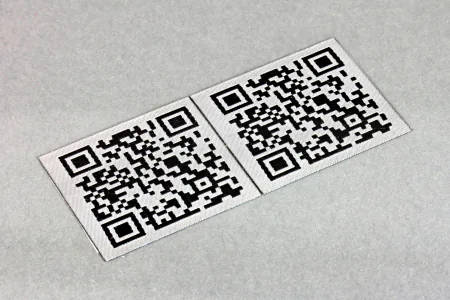
Woven labels are used in clothing for the brand mark and size, in footwear, hats, bags, accessories and home textiles. The same jacquard technique produces jacquard webbing with a logo, jacquard elastic tapes and patches. A QR code can also be woven into a label.
Frequently asked questions
What is the difference between a woven and a printed label?
On a woven label the design is made of yarn and does not wear off. On a printed label the ink lies on the surface of the tape, which allows more small text but is less durable.
How many colours can a woven label have?
Usually a few: a ground colour from the warp and several weft colours. The exact number is agreed for the specific design and size.
What file should I send?
A vector PDF with text converted to outlines, or a CorelDRAW file, works best. A logo or a description is enough to start the conversation.
Will the label colour match my brand colour exactly?
The yarn is chosen from a shade card as close to the reference as possible, but yarn in a weave always looks slightly different from print or a screen. A sample is worth ordering for brand colours.
Sources
- Wikipedia, “Jacquard machine”, en.wikipedia.org
- Label weaves and edge finishes: common terms used by label manufacturers