Materials
Webbing by material: polypropylene, polyester, cotton, acrylic
The same construction behaves differently depending on the fibre. A review of webbing materials, their properties and uses.
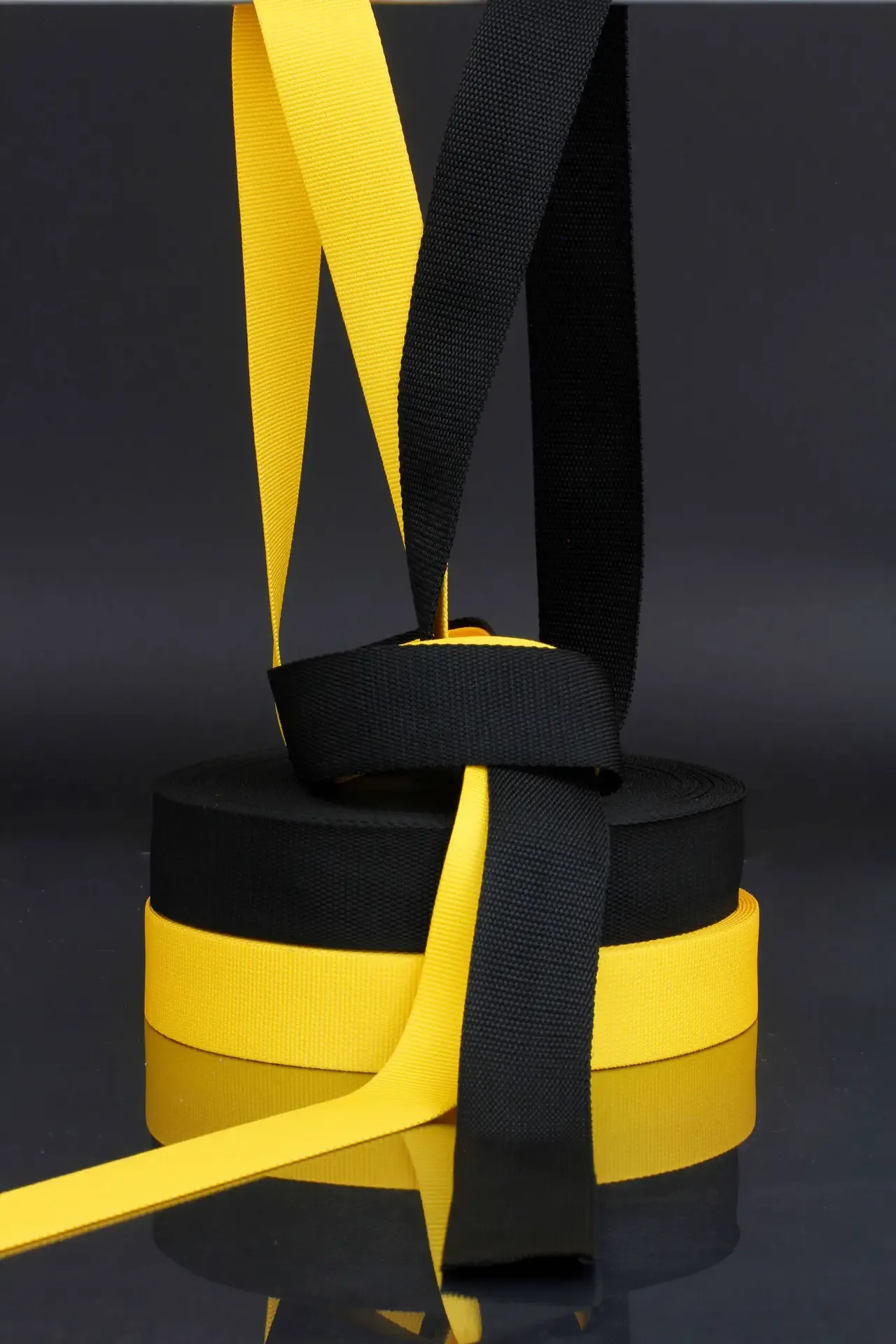
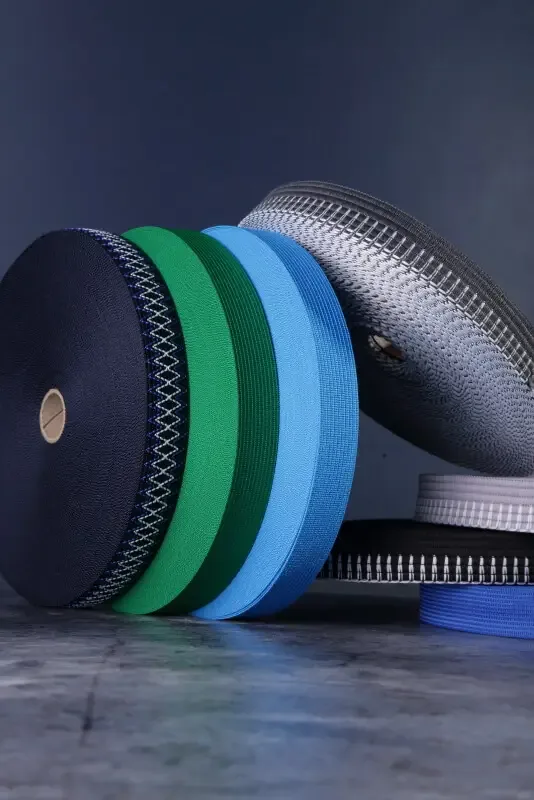
Webbing is a strong fabric woven as a flat strip or tube, of a fixed width and with finished edges. Lighter woven, knitted or braided strips are usually called tapes. Two things decide how webbing behaves in a finished product: its construction and its fibre. Constructions are described in Types of textile webbing and their applications. This article sorts webbing and tapes by the fibre they are made of.
Materials compared
| Material | Fibre properties | Dyeing and printing | Typical uses |
|---|---|---|---|
| Polypropylene (PP) | Very light, with a density of 0.90 to 0.93 g/cm³, which is less than water. Melts at 160 to 166 °C. | Coloured with pigment in the melt. Degrades in sunlight unless stabilised. | Load-bearing webbing for bags and backpacks, bundling and strapping tapes, garden products. |
| Polyester (PES) | High strength, low water absorption, minimal shrinkage. | Dyed with disperse dyes. The only one of these fibres that takes sublimation printing. | Technical and garment webbing, lanyards, jacquard webbing. |
| Cotton | A natural fibre of almost pure cellulose. Absorbs moisture, soft and matt. | Takes dye well. Printed by screen printing or heat transfer. Sublimation does not work. | Decorative tapes, bindings, ribbon for packaging, garment trims. |
| Acrylic | Light, soft and warm, with a wool-like feel. Holds colour well. | Colour is most permanent when the fibre is pigmented in production. | Decorative tapes, drawcords, trims for knitwear. |
| Polyamide (nylon) | Very resistant to abrasion, smooth and resilient. | Dyes easily but absorbs little moisture. | Lingerie tapes, elastics, heavily loaded straps. |
| Aramid | Resists high temperature and cutting. | Limited range of colours. | Technical webbing for protective clothing and special applications. |
Polypropylene webbing
J. Paul Hogan and Robert Banks of Phillips Petroleum first polymerised propylene in 1951. In March 1954 Giulio Natta and Karl Rehn obtained isotactic polypropylene, and Montecatini began producing it commercially in 1957. The fibre is lighter than water and does not absorb moisture, so polypropylene webbing does not soak through and dries quickly. It is coloured by adding pigment to the molten polymer. Its weakness is sensitivity to sunlight, so yarn with a UV stabiliser is used for products that stay outdoors.
Bundling and strapping tapes
Polypropylene and polyester are also used for bundling and strapping tapes, which hold products together in bundles, packs and loads. Polypropylene is the economical choice for light and medium loads. Polyester is used where the tape must carry more force and keep its tension for a long time.
Polyester webbing
John Rex Whinfield and James Tennant Dickson of the Calico Printers' Association in Manchester patented polyethylene terephthalate in 1941. The fibre reached the market in the 1940s as Terylene, and DuPont began producing Dacron in 1950. Polyester is now the main raw material for webbing: it is strong, shrinks little and does not absorb water. It is the only fibre described here that suits dye-sublimation printing, which is why white polyester webbing is the base for lanyards and promotional tapes.
Cotton tapes
Cotton fibre is almost pure cellulose. Under normal conditions it holds about 8.5% moisture, which gives a pleasant, natural handle but also means slower drying and more shrinkage than synthetic fibres. Cotton tapes are chosen where look and feel matter: decorative tapes, bindings and ribbon for packaging. A logo is applied by screen printing or heat transfer, or woven in by jacquard.
Acrylic tapes
Acrylic fibre contains at least 85% acrylonitrile. DuPont made the first such fibres in the 1940s under the name Orlon. Acrylic is light, soft and warm and holds colour well, so it replaces wool in decorative tapes and knitwear trims. It is more flammable than natural fibres, which limits its use in technical products.
How to choose the material
The choice starts with the conditions in which the webbing will work. Contact with water and low weight point to polypropylene. Strength, stable dimensions and full-colour printing point to polyester, and a natural look to cotton. Polyamide suits heavy abrasion and aramid suits high temperature. Requirements for technical webbing are covered in Technical webbing for B2B manufacturing.
Frequently asked questions
Which webbing is the lightest?
Polypropylene. Its density is 0.90 to 0.93 g/cm³, which is lower than the density of water.
Can cotton tape be sublimation printed?
No. Sublimation dyes bond with polyester. Cotton is screen printed or heat transfer printed, and a logo can also be woven in.
What is the difference between polypropylene and polyester webbing?
Polypropylene is lighter and cheaper but copes less well with sunlight and heat. Polyester is stronger, more stable in size and suitable for sublimation.
What are strapping tapes used for?
For holding products together in bundles and packs during storage and transport. They are made mainly of polypropylene and polyester.
Sources
- Wikipedia, “Polypropylene”, “Polyester”, “Polyethylene terephthalate”, “Acrylic fiber”, “Cotton”, “Nylon”, en.wikipedia.org
- Wikipedia, “Webbing” and “Strapping”, en.wikipedia.org